SEMINARS & TRAINING
A Connecticut Nuisance Wildlife Control Operator (NWCO) training course is being held to offer the training to qualify for a NWCO license. Attendance at this course is required for all new NWCO license applicants, municipal employees who engage in the control of nuisance wildlife (except for the emergency control of rabies), and any previously licensed NWCO who has not completed this training and wishes to renew their license.
Following the training class there will be a state administered NWCO examination on Friday, June 21, 2024. Time and location to be announced.
2024 classes: March 15th, June 14th, and October 11th.
Sign-up Form
Date:
June 14, 2024
LOCATION:
Training class will be held at Cabela’s
475 East Hartford Blvd. North
East Hartford, CT 06118
Starting at 9:30am
The NWCO exam is comprehensive and requires a thorough understanding of a variety of subject areas including:
Wildlife biology, reproduction, food habits and behavior of all species included in Connecticut’s Nuisance Wildlife Control Operator Policies and Procedures Booklet. Increased attention should be given to several of the most commonly encountered “nuisance” species (i.e. gray squirrels, raccoons, striped skunks, woodchucks, flying squirrels, opossums, and bats.
Identification of common wildlife through field sign [i.e. tracks, (see DEP Guide to animal tracks) scat, etc.] and typical damage caused by these species.
Practicing an Integrated Wildlife Damage Management (IWDM) approach to prevent and control nuisance wildlife that includes:
- Educating Homeowners
- Cultural Practices/Habitat modification
- Frightening and Repellent use/
- Humane capture, handling, and transport including the proper use of live traps, one-way doors and kill traps
- Exclusion/Animal proofing techniques
- Relocation and release guidelines
- Handling young animals/preventing orphaning
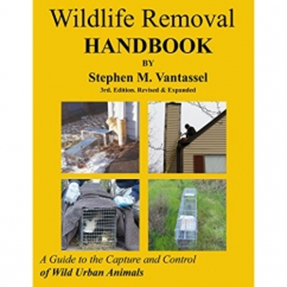
CTNWCOA strongly recommends that you purchase and read the Wildlife Removal Handbook before attending the training class.
Wildlife Removal Handbook
By Stephen M. Vantassel
Other suggested references include the following:
- Wildlife Informational series from the CT Department of Energy and Environmental Protection (DEEP) website, most common wildlife fact sheets.
- CT NWCO Policies and Procedures Booklet Two new species, red squirrel & flying squirrels, are also enclosed for study purposes. Red squirrels do not require a NWCO special permit to trap but flying squirrels do.
- NWCO Policies and Procedures Update (8/25/03)
- CGS 26-72 Regulation of Trapping of fur-bearing animals and 26-66-5 Trapping.
General
- Bat Rabies-What You Should Know, 10/95, CT Department of Health
- Rabies Fact Sheet
- May is Rabies Awareness Month, Reprint from May/June 2008 CT Wildlife
- A Guide to Animal Tracks
- Nuisance Wildlife Control and Rabies
- Prevention & Control of Wildlife Damage, 1994 University of Nebraska Cooperative Extension, Hygnstrom, S.E., R.M. Timm and G.E. Larson. 2 vols., over 500 pages. Wildlife Damage Handbook, 202 Natural Resources Hall, Univ. of Nebraska, Lincoln, NE 68583-0819. Phone: 402-472-2188.
- Wild Neighbors: The Humane Approach to Living with Wildlife, 1997. The Humane Society of the United States, Hadidian J., Hodge G., and Grandy J. 288 pgs. The Humane Society of the of the U.S., 2100 L Street NW, Washington, DC 20037. Phone: 202-452-1100
- Wildlife and Diseases - Biohazards Associated with exposure to animals; French, R. DVM, NE Center for Wildlife Diseases, University of CT, 12 apps. (Rabies, Lyme Disease, Raccoon Roundworm, mange)
- A Field Guide to the Mammals, 1976 Peterson Field Guide Series, Houghton Mifflin Co., Burt, William H. and R.P. Grossenheider, 289 pp.
- A Field Guide to Animal Tracks, 1978 Peterson Field Guide Series, Houghton Mifflin Co., Murie, Olaus J.
Training Course Handouts/Informational Material (day of class)
- Nuisance Wildlife Control Operator Training Outline
- 1993 Report of the AVMA Panel on Euthanasia, Journal of The American Veterinary Medical Association, Vol. 202, No. 2, pp. 229-249.
- Connecticut Public Act 98-199 (NWCO Statute 26-47(b)(1) through 26-47(d) and Section2*
- Client Notification Requirement-Approved Lethal and Nonlethal Options to Resolve Common Nuisance Wildlife Problems
- Connecticut DEP Laws and Information on the Use of Pesticides by NWCOs
- Some Commonly Recommended Repellents for Use in the Control of Nuisance Wildlife
- Wildlife Rehabilitation in Connecticut
- Animal Development Milestones- General Guidelines to Determine the Age of Young Animals
Please contact Training-coordinator or call 203-871-1519 if you have any questions.